Saturday, December 2, 2023

My Ron Cook Studios website is changing. I "sort of" retired from my wood art, but once in a while I do occasionally head for my studio to make a few small items for my Etsy shop.

At this point in my life I have switched over to writing novels full time. I have two paranormal mysteries published (Firebrand and The Last Family of Wizards) as well as a memoir (On Guard in the General's Chorus), a book of short stories and mystery novelettes (Onward Through the Fog). I also have a book of poetry and contour drawings (A Young Upstart).

For information on my books, ebooks, and audiobooks, go to my Ron Cook Author website.

Until next time...


Thursday, September 15, 2022

End of Summer Notes

September in Santa Cruz is usually sunny and warm. We did get a week of very nice warm weather that allowed me to barbeque several days, followed by a few days of early fog then pleasant afternoons.

Even though I’ve retired from “active duty”, I’m still occasionally tinkering in my studio, making a few small items for my Etsy shop. However, I am not taking on anymore restorations and repairs.

So, what am I doing now (besides some yardwork)? Writing. Getting published.

New Work

Yes, my new book is out. It is called Firebrand, and it’s my first full novel. Here is the synopsis:

Charles Blue had grown up in a middleclass neighborhood with no idea of his family background. His parents’ tragic and suspicious death by fire changed that.

A grandmother, a San Francisco fortune teller and part owner of the Mystic Eye Occult Shop, took Charles into her home and started to teach him about his hidden “abilities”. For 25 years, Charles barely accepted his powers, then friends began dying by fire.

He and his girlfriend Bell now had a reason for learning all they could about incantations and spells to combat a powerful, unknown adversary.

A Charles Blue Paranormal Mystery Available through Amazon, Barnes & Noble, and worldwide online and through independent bookstores.

Hope you enjoy it!

Old Work

I’ve been writing since grade school. In college, I was an English major and took several writing courses. I won two awards for a couple of my stories and that triggered the need to continue writing, even while pursuing my craft… early American and medieval European stringed instruments and furniture.

Even before I retired, I published four other books. Here they are:

Onward Through the Fog

Eight short stories of drama, comedy, adventure, and reminiscence, and two mystery novelettes: “The Great Pearl Alley Caper", and “The Girl Next Door”. 

The short stories include a wannabe beatnik/hippie/punk, a frustrated writer, a lovesick coworker, a remembrance of childhood, and a peace-seeking individual in a not-too-peaceful situation.

 In the two novelettes, wine bars and bistros are meeting places for heroes and villains, for the workingman and bum, for loves won and lost, and for rising body counts.

Available through Amazon, Barnes & Noble, and Lulu.com

A Young Upstart

In 1977 I entered a period of my life where self-doubt and depression were nearly everyday occurrences. Not liking these attitudes, I began self-analysis using the Gestalt therapy teachings of Fritz Perls.

From 1977 to 1980 I hung out at the Upstart Crow Bookstore and Coffeehouse at the Pruneyard Shopping Center in Campbell, California. It was in this wonderfully social environment that I began sketching hundreds of contour drawings of patrons and writing poetry and stream of consciousness meanderings. This book is a compilation of many of those works.

Available through Amazon, Barnes & Noble, and Lulu.com


On Guard in the General’s Chorus

Korea, 1967 and 1968. The Vietnam conflict was escalating. The cold war was raging. Robert Kennedy and Martin Luther King had been assassinated. In Korea, the Navy ship USS Pueblo was captured, and over a dozen North Koreans tried to blow up the South Korean president.

And at Recreation Compound #1, barely two miles from the DMZ, forty touring Army musicians and singers attempted to keep sane through it all. Boo was a dollar a lid.

Available through Amazon and Barnes & Noble


And here is the very first book I published:

The Mountain Dulcimer

This book is a guide for beginning dulcimer players in the joy of playing their instruments. After a short historical section, I explain the modes and how to tune your dulcimer to play in the different major and minor keys. Included are several classic folk songs. These are shown with musical notation showing the melody as well as tablature notation showing the dulcimer notes and/or rhythm.

Available through Lulu.com


As you can see, I’ve been busy writing for many years. Oh, and…

One More Thing

I’m currently working on book 2 of the Charles Blue Paranormal Mysteries. Here’s a peek:

The Last Family of Wizards

In 1990 Charles and Bell have had a month of calm enjoying the comfort of his Santa Cruz home while his San Francisco home is being remodeled after the 1989 earthquake.

Their calm is short lived when they agree to investigate the flash and disappearance of a young musician. This takes them to the gold rush town of Volcano, an area of mystery and danger.

A Charles Blue Paranormal Mystery #2 coming in 2023


To keep up on my books, me, and what’s up in the world of writing and publishing, check out my website, www.roncook-author.com.

That’s it in my writing world.

A Little Other News

I recently bit the bullet and picked up the new M2 Apple MacBook Air. It’s a lovely computer with a slightly larger screen and a super-fast CPU. It runs hundreds of times better than my older Intel-based MacBook Air. Oh, and thousands of times better than our 7-year-old HP desktop computer. My MacBook Air is my digital writing typewriter.

In the Studio

Just a quick note on studio work. I’ve been using up some scrap wood and tagua nuts to make buttons. To check them out, they are on my Etsy shop.

I still have a few larger unfinished pieces, like a teardrop dulcimer, a medieval stool, and several turned and carved boxes and lids. Like I mentioned above, I’m just occasionally tinkering in my studio… not spending 4 to 6 hours a day in there anymore. But whenever anything gets finished, you’ll see it on my Etsy shop.

Tuesday, January 25, 2022

Time to Retire

Dulcimer number oneOver fifty years ago, in 1970, I made my first dulcimer. It was a simple solid-body electric dulcimer made from a trashed, cheap Japanese electric guitar. I pulled the frets off the guitars neck to use for dulcimer frets. The electronics, pickup, volume and tone controls, and tuning gears also came from the guitar. The body was a piece of 3/4” plywood, shaped like a standard hourglass dulcimer, and painted white. It worked great, and I even used it on stage when our group, Throckmorton, played a rock version of “Shady Grove”. I still have it hanging on my studio wall.

Since then I’ve made over 500 instruments, furniture pieces (medieval and modern), sculptures, and wood turnings. I’ve taught wood carving at Cabrillo College, and I’ve taught wood turning, wood carving, luthiery and general woodworking in my studio and shop for twenty years. For the last twenty-five years, I’ve been restoring antique and vintage stringed instruments. I became the go-to person in North America for zither repairs, both concert style and chord zithers. I’ve restored many dulcimers, ukuleles, guitars, and even autoharps.

From 2001 to 2016 I exhibited at craft shows and arts festivals across the country, at one point attending six shows a year. I was juried into many American Craft Council shows, starting out in Charlotte, North Carolina, with three years in the ACC flagship show in Baltimore, and too many to count in ACC San Francisco. There was the Bellevue Art Museum show in Washington state for three years, six or seven years in the Scottsdale Arts Festival in Arizona, and a few years each at the King’s Mountain Art Fair and the Sausalito Arts Fair.

I’m tired. After all that, it’s time for me to retire. Well, about time to retire.

New Work

MbirasI still have my Etsy shop, and the last two years have been very good. To keep it fresh, I will still make an occasional small instrument, furniture piece, or sculpture.

Since December, I’ve made three Mbiras (thumb pianos), two large ones and one mini. Also, one of the Mbiras (left in photo)  is electric with an internal pickup. It also has a volume control knob.

The electric one is salvaged cocobolo with a maple sound hole rosette. The mini is purpleheart with maple binding. The one on the right in the photo has a salvaged cocobolo back, wenge (pronounced whengay) sides, and spruce top. The little hammers are for tapping the tines for tuning. These three mbira’s are available on Etsy.

NotersAt the end of 2021, my stock of dulcimer noters was down to one. This last week I finally started carving some more. These are the newest ones.

The one on the left is salvaged cherry. The middle one is salvaged black walnut. The one on the right is salvaged white oak. These are also available on Etsy.

Be sure to check out Etsy for all my original pieces. Shipping is free.


On The Workbench 

I am currently working on my last two restorations, zithers I had promised to do late last year. The concert zither on the left is an Anton Kiendl zither from around 1899. This is the second of two identical Anton Kiendl zithers I’ve restored for the same customer. The chord zither on the right is a Phonoharp Model 2. When I’ve finished restoring it, it will have five chords and fifteen doubled strings. This zither had a very scaly “alligator” surface, large cracks on the back, and the frame was coming apart. I had to remove the back to make all repairs.  Fink and Kip Zithers

Last November I was commissioned to make a custom dulcimer cane. This is my last commission. Like the last time I was commissioned, I’m making a second one to sell on Etsy. These are numbers 5 and 6.They both have maple bodies with a decorative piece of black walnut on the back. Dulcimer canesThe fingerboards, handle, and “foot” are black walnut.

My dulcimer canes are based on an 1845 original from Mirecourt, France. The original was a four-string guitar. I adapted the design as a Mountain dulcimer. All the dulcimer canes I’ve made have been very popular.

The unfinished dulcimer cane (top in photo) will be available on Etsy when completed.

And…

Retirement doesn’t mean I’m going to sit around and watch television all the time. No, I will be using my time writing more. I’ve actually been a writer since grade school, and when I was working in the private sector, I was a technical writer. I’ve been published in several magazines and trade journals and published four books so far. Lately, I just finished another novel (still in edit mode) and started another. More news about this coming in future blogs.

For now, it’s time to finish up these last restorations and instruments then celebrate with a glass of vino!

Friday, September 24, 2021

Open Studios Art Tour is Back

After nearly two years, the Santa Cruz County Open Studios Art Tour is back! This wOpenstudios21 Postcard-4x6-front-72ill be my 20th year opening my studio to the public. I am listed in the Artist Guide as Artist #253 and will be open from 11 to 5 on October 9-10 and 16-17. A preview exhibit is opening at the Santa Cruz Art League on First Friday, October 1.

What will be different this year is that my exhibit will be outside only and next to my studio. (Hopefully the rains will hold off!) The Arts Council is also suggesting visitors wear masks when visiting artist’s studios. They have given artists a set of masks to give out if necessary.

I have several new pieces to show, and I hope to see you here on the second and third weekends in October.

Because there was no Open Studios in 2020, the Arts Council created the Visual Arts Network. It is still active online and is a good place to see the works of other Open Studios artists.

New Work

Porter Dulcimer Cane w-standA few months ago a customer from Oregon wanted me to build her a dulcimer cane. I had built two of them before, and one sold, but, unfortunately, one was stolen from a gallery showing. My customer had seen the one I sold on Etsy, and she wanted one similar. She uses a cane, and I asked her how high it was. I built her dulcimer cane to the same height. This one has a maple body with salvaged black walnut handle and fingerboard.Porter Dulcimer Cane-head detail2 There is also salvaged ebony for accents. It has a very bright tone.

While making this commissioned piece, I decided to make a Dulcimer Cane2-72second similar one but with a different carving and several inches taller. It is made with the same woods. Dulcimer Cane detail2I finished it around two weeks after completing the commission and put it up for sale on Etsy.

That didn’t last long. It was on Etsy for barely 10 days and sold. It’s going to a new home in Colorado.

Other instruments that have been very popular this last year are the Saxon and Germanic Lyres (Rotes), both full sized and the smaller “mini” sizes. Because of the popularity, I had to make a few more.They are also on Etsy.

One of the newest instruments I crafted is the Mbira, also known as an African thumb piano. The first one I built sold on Etsy right away, so I made a second. It also sold right away. So, I made another. This one is salvaged mahogany sides and back, salvaged first-growth Douglas fir top, flamed maple binding, and a black walnut and maple soundhole. Like the other Mbiras I made, it has a bright lovely tone. It is available on Etsy.

In the Studio

There are several pieces I’m currently working on. Lately, I’ve been working a little more  on my Ottavina (Octave Spinet). I added some old-style hinges to the key cover and the top. I also made a post for holding the lid up. (Like a Ottavina-opentop on a grand Ottavina-closedpiano.) The next “big” project is to layout for the strings, then make a rail for the jacks (plectrum) that will pluck the strings. I originally started work on this octave spinet (which is a type of harpsichord) back in the mid to late 1970s. The case I built then was not up to my standards today. I made a new case of black walnut using angled dovetails. The stand is also black walnut.

On my workbench are parts for another teardrop-style dulcimer. Once again the woods are salvaged. The top, back, and sides are cocobolo, which is a Central American tree. I’m about ready to carve the head and tailpiece, which are hard maple. Cocobolo dulcimer-parts-72Once I finish carving, assembly will go fairly quickly. The whole process takes around 20 hours or so over two to three weeks.

In addition to my studio, I have a shop in my garage where I have my large power tools, like my table saw, 17 inch band saw, drum sander, spindle sander, and a large belt and disk sander. This is where I work on larger pieces and do antique stringed instrument restorations.

12x12-pipe organ-72A project I’m working on now is a small pipe organ. It’s mostly maple and some black walnut. The pipes are pine and oak.  I hope to have it finished in a couple of weeks so I can enter it in the 12 x 12 (x 12) event at the Cabrillo College Gallery later in October.

Recently I was watching a virtual American Woodturners Association Zoom-type broadcast of a woman woodturner who used power carving devices for embellishing turned vessels. One of her power carving tools was a high speed device that seemed to cut through the wood like butter. She swore by it. I had to have one.

New carver-72After some research, I finally found the carver at an online storefront. As the woman woodturner said, it does cut through wood like butter. My Foredom and Dremel with flex shafts run up to 15,000 rpm. My new Marathon III Micromotor runs over 30,000 rpm allowing me to make highly detailed carvings. What is also nice about the Marathon is the handpiece has a quick change feature. Extremely easy to change bits. No wrenches needed!

Restorations

Since my last blog, I’ve restored three more zithers. Two were German made concert zithers, and one was a U.S. made chord zither.

Done3-72This one is a Circa 1900-1910 Job. Bartholomä Concert Zither. Bartholomä has been used as a last name in Germany, especially the Bavarian region, but now is more commonly spelled Bartholomew. Bartholomä is also a small town in the hills east of Stuttgart and southwest from Nurenberg. It’s very possible this zither could have been made in Nurenberg, which was a major center of concert zither manufacturing in the late 1800s to just before WWI. Stuttgart also has had some zither manufacturers but is now an industrial city where Mercedes and Porsches are made. Read my repair log here.

Completed-72This larger one is a Circa 1903-1917 August Schulz Concert Zither. Because of the size, it was sometimes called an Alpine zither or a harp zither. This fine zither was crafted in Nuremberg, Germany by August Schulz. What I could find from my research was that the workshop was in operation from 1902 to 1917. Operations probably ceased because of World War I. There were actually more August Schulz guitars made than zithers. August Schulz also made lutes. Read my repair log here.

Completed-72

This chord zither on the right is a Circa 1900 Home Educational Co. Mandolin Guitar-Harp. Of course, this is not a mandolin or a guitar. It is closer to a harp because it is plucked.

Chord zithers, often called Guitar Zithers, were extremely popular from the late 1800s to the mid-1900s. Hundreds of thousands were made by several companies, including Friederich Menzenhauer, Oscar Schmidt, and Phonoharp. Phonoharp, of East Boston, Massachusetts, made several different models of chord zither, each one manufactured in the thousands. These were primarily sold in Sears and Montgomery Ward catalogs as well as door-to-door. Some Phonoharp models, called Mandolin Guitar-Harps, were distributed by the Home Educational Company of Concord, North Carolina, who applied their own labels inside the instruments.

This zither need extensive work to restore it. You can read my repair log on my website.

Do you have a zither or other stringed instrument needing restoration or repair? Is is a family heirloom you want to play and/or save for posterity? If you do, send me an email, along with photos or the instrument (especially problem areas on the instrument), so I can give you a quote on my services. My email  is ron@roncookstudios.com.

That’s it for now. Remember, Open Studios is coming up. My studio is open 11-5, October 9-10 and 16-17. See you then!

Thursday, March 18, 2021

One Year Ago…

We are now one year into our pandemic self-quarantine. It seems incredible that exactly one year ago, my wife and I were in San Diego volunteering for the annual Left Coast Crime book convention and anxiously awaiting the impending excitement of it when notice was posted at the end of the first day that the event was closed and after one last evening of nervously socializing we hurried home to lock ourselves up for the duration. We're doing well and finally got our first "anti-Covid" shot a few weeks ago. We'll have our second one shortly. There have been no arts and crafts shows during this time except for a couple of virtual gallery exhibits at the end of last year. I've been making a lot of sawdust in both my studio and my shop and working on new furniture, instruments, and carvings, and also been working on antique instrument restorations for customers. I've been writing! (I have to use my gallery for something, after all, so I use it for writing.) To read more about what is going on in my little corner of the world, see below.

In the News

50th Anniversary Dulcimer

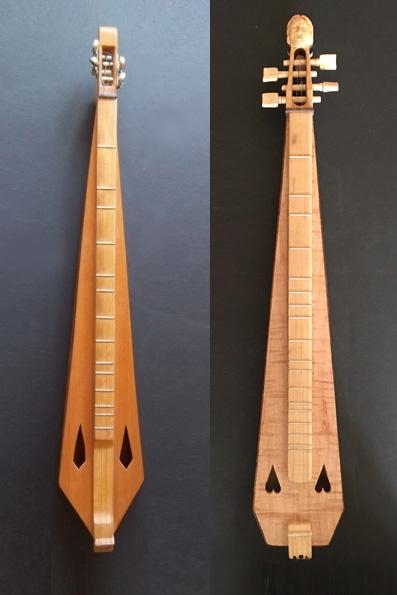
Fifty years ago I made my first mountain dulcimer. It was a simple coffin-shaped instrument with mechanical gears from a broken guitar. The frets were reclaimed from that same broken guitar. It was coffin shaped because I hadn't yet learned how to steam bend wood for curved sides. The woods I used were cheap mahogany and pine. I played it on stage in one of the bands I was in back then. (Photo below on the left.)

My 50th anniversary dulcimer (photo below on the right) is shaped the same, but with much better wood than my first: nice figured maple. Whereas my first had a simple head stock, this one has a head carving. It also has hand-carved tuning pegs. My first dulcimer had a very sweet sound and my new one sounds even better.

Symphony #3

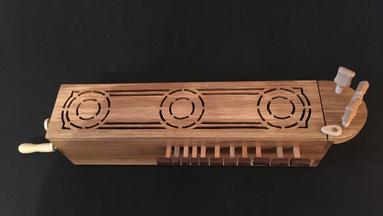
This is the third of my popular "Cantigas de Santa Maria" symphonies. It is made of white oak with maple pegs, tangents (button keys), wheel and handle. The soundboard is 100+ year old salvaged first-growth Douglas fir. The tangent ends are black walnut. The bridge is laminated salvaged ziracote. The handle shaft that turns the wheel runs into the box through the wide-open mouth of a character's face that I carved out of a tagua nut. It has two melody strings and two drones.

Like my other symphonies, this one is also based on an image in the 13th century Spanish illuminated manuscript "Cantigas de Santa Maria" by Alfonso X, which is a series of songs and prayers to Mary profusely illustrated with images of characters playing the instruments of the time. I've made several of the instruments.

Resonator Dulcimer

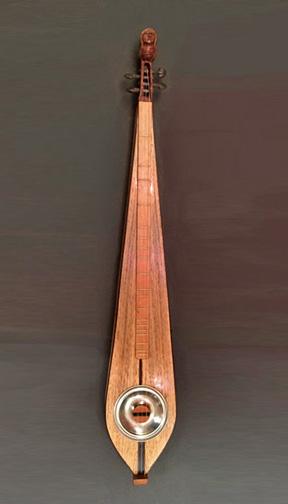
Before I completed my 50th anniversary dulcimer, I finished another I had in the planning stage for several years, a resonator dulcimer. The 5 inch "paint lid" resonator is hand-spun aluminum and has a biscuit bridge similar to the National Guitar style. This one is 28 inches from nut to bridge. The body is several inches longer than my traditional dulcimers and a little thicker. The resonator and the large "box" size give this dulcimer a very interesting and lovely sound.

Restoration of Aug. Richter Zither

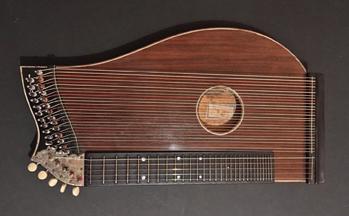
This year started out with a restoration of a lovely German concert zither that was made sometime in the 1920's by Aug. Richter, who belonged to a family of instrument makers in Munich.

The owner purchased this through eBay and got a great deal on it. It had no strings, the metal bridges were lost, and five of the tuning pins were missing. Fortunately, the frame was solid and there were no cracks. I just finished restoring it, and I'm now putting together the repair log, which I'll post on my web site when it's finished.

Finished2-72

Restoration of West German Jubeltone Zither

Earlier this month I was sent another Jubeltone chord zither to restore. I restored another identical instrument a couple of years ago. That one I had to totally disassemble because it had cracks on the front and back and some failed glue joints. The one I just finished was in better condition. It did have two shrinkage cracks in the back and some corrosion on the hardware and strings. It was missing only one string, and I was able to salvage all the existing strings. This brand of zither was made in the 1960s before German reunification in 1990. It even has a stamp on the back stating it was made in Western Germany. It might have been made in Munich, which was a zither manufacturing center since the 1880s.

Etsy

The instruments and folk art pieces I completed in the last twelve months are all on my Etsy shop. More coming soon.

It's been a good year, and several of my instruments have gone to good homes. I believe people who are sheltered in place have put their time to good use by playing music or learning to play music.

Behind the Scenes

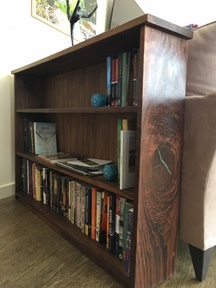
I took some time out from working on instruments and medieval furniture to build a bookcase for the back of the loveseat sofa in our living room. We've accumulated so many books over the years at mystery book conferences and bookstores. They were stacked by the bed, three deep in our large built-in bedroom bookcases, and stacked in piles in the living room. Now we have much more room for them. It's all black walnut. One side had a large open knot, so I filled it with a turquoise epoxy. It turned out wonderfully. It is so wonderful that my wife wants one, too, for her craft room.

Hot off the Press

Besides loving to do woodworking for over 50 years, I've always loved to write and have been writing stories since grade school. I recently published my third book, "On Guard in the General's Chorus." A semi-fictionalized memoir of my time in the army, 1966-1968, primarily during my time in Korea in the entertainment corps.

A little over a year ago, I published "A Young Upstart", a series of poems and stream of consciousness writings, along with some of the hundreds of contour drawings I made in the late 1970s.

"Onward Through the Fog", published several years ago, is a series of short stories and two mystery novelettes, many that I started writing in English classes at San Jose State back in the mid 1980's.

All three books are available at independent bookstores, Amazon, and Barnes & Noble.


That’s it for now. Later today we’re getting our second Covid-19 shot (ouch). Now two weeks more of sheltering, then we can look forward to getting out a little more (still masked, of course). As I always say, onward through the fog…

Saturday, August 29, 2020

Fired Up

Over a week ago we had a very unusual, for our Santa Cruz coastal community, large lightning storm. According to the weather service, we had over 11,000 lightning strikes. This was the remnants of a Pacific hurricane off the Baja Mexican coast. Unfortunately, there was no rain involved, and the storm only produced dry lightningAsh-covered Jeep-better. Dry lightning on dry forests and fields. The resulting 7000 fires have now consumed over 1.4 million acres. More than 120,000 people were evacuated in Santa Cruz and San Mateo counties. At last count, over 500 homes and structures were lost, just in our county. Ash has fallen all over. (Notice my ash-covered Jeep in the photo.) Fortunately, we are far enough away that we were not threatened by the fires. But, added to the fires, we’ve had over five months of Covid-19 sheltering and mask wearing. Back in early July, Santa Cruz partially opened up, but that was short lived. More people tested positive, and things shut down again. Only a few restaurants and wineries with spaced outdoor seating have been able to keep partially open. This 2020 is turning out to be one hell of a year. Now, if we can just get through the Fall election.

Sigh… Enough of that…

Through it all, I’ve been fortunate to have a lot to do. My woodworking craft is advancing, and I’ve actually had seven Etsy sales, six of them large instruments.

New Work 

A few weeks ago, I finished carving a new dulcimer head and tailpiece for a resonator dulcimer I’d been planning to make before the pandemic locked us down. I purchased a 5 1/2 inch “paint lid” resonator Reso-dulcimerand biscuit bridge from C.B. Gitty, and made a special dulcimer top the resonator would fit in. I just glued the top on, and I’m ready to sand it down and then add the fingerboard. This dulcimer has cocobolo top and back and figured maple sides. The head and tailpiece are walnut, and the fingerboard is maple laminated over pine. I still have binding to do then a lot of sanding.

Waiting in the wings is another teardrop dulcimer. This will be a regular dulcimer with no additional bells and whistles…

Symphony-three photos combined

Another instrument I finished recently is my third Symphony. Again, I based this on a 12th century Spanish illuminated manuscript known as “Cantigas de Santa Maria”. This one is cherry, with maple tuning pegs, tangents, and handle. The one thing different with this Symphony is the hand-carved tagua nut head with the wheel handle coming out of his mouth.

It’s another lovely sounding instrument that harkens to the early medieval period. Picture monks sitting around chanting their offices in Latin while accompanying themselves on one of these instruments.

Before the Symphony, which was first created around the 1100s, was the Organistrum, which took two people to play. This was the first “hurdy gurdy-type instrument” and had a crank that turned a wheel. It predates the pipe organ and was used for the same function: to play notes to help everyone sing their offices in the same key.

Lesson time:

If you have read (or watched) Ellis Peters’ Brother Cadfael, you might have read or that the Benedictine monks always chant (and pray) during the following offices:

  • Matins (during the night, at about 2 a.m.)
  • Lauds or Dawn Prayer (at dawn, about 5 a.m., but earlier in summer, later in winter)
  • Prime or Early Morning Prayer (First Hour, approximately 6 a.m.)
  • Terce or Mid-Morning Prayer (Third Hour, approximately 9 a.m.)
  • Sext or Midday Prayer (Sixth Hour, approximately 12 noon)
  • None or Mid-Afternoon Prayer (Ninth Hour, approximately 3 p.m.)
  • Vespers or Evening Prayer ("at the lighting of the lamps", about 6 p.m.)
  • Compline or Night Prayer (before retiring, about 7 p.m.)

If you noticed, there was not much time in those days to do other work around the abbey grounds, barely two hours at a time before the bell rings for the next office.

End of lesson.

New thumb pianoAnd now for something completely different. (Not Monty Python!)

I just started making a thumb piano, also known as a Mbira or Kalimba. I found a source for the flattened spring steel notes online and decided to order them. Many many years ago I purchased one of these at an arts festival I attended (long before I became a vendor at the same type of art festival), and have always loved the sound. Three years ago my wife went on a bus and cycling tour of Namibia. She brought back to me a primitive, but extremely lovely, hand-made Mbira, which also has a beautiful sound. Both of these inspired me to make one of my own. It is turning out to be quite a fun project.

I have the body made, and I’m making a top with a hand-carved quatrefoil sound hole similar to what I use on my psalteries and other instruments. The top and back are from a piece of redwood burl, and the frame is black walnut. All woods are salvaged.

Restorations

Since I don’t have any current customer instrument restorations, I’ve lately been working on restoring several of my own antique and vintage autoharps and zithers. Sometime later in the year, I’ll be re-opening my Vintage Etsy shop and put these up for sale. So far, I’ve restored three antique Zimmerman autoharps, all from the 1883-1899 time period. All three autoharps were made by Charles F. Zimmermann in his Dolgeville, New York plant.

Z-model 2 34-1Z-model 73Z-model 2 34-2

The left and middle photos are both Zimmermann Model 2 3/4 autoharps. They have five chord bars. The left one is the earliest, from around 1885-86. It has a lovely stained natural wood (spruce) top. The middle autoharp is a few years newer (1887-88) and is all black. The top is also spruce, but painted black to match the sides and back. The right autoharp is the very familiar Model 73 with 12 chords. Even though Zimmermann’s Dolgeville Company closed when he died in 1889, the Oscar Schmidt Company restarted autoharp production with this same model. The Oscar Schmidt name is now owned by the Washburn Guitar Company, and Washburn is continuing the production of several Oscar Schmidt branded autoharp models, including the Model 73. This model has been around on and off for 140 years.

Chartola GrandI’m now working on what is known as a “gizmo” harp. The label says it is a Chartola Grand, distributed by the Chartola Grand Company, which is actually made by the Menzenhauer/Schmidt Company and has four chords that have spring-loaded “thumpers” that snap on the chords to play them. This is the before photo. I’ve just started removing the strings and tuning pins. It does have a full set of strings that seem to be in decent condition, so as I remove them I put a piece of tape on them denoting what note and number it is. That way I’ll know exactly where each string goes when I restring the instrument. Also, the zither’s body has no cracks or failed glue joints. Just a nice cleaning and waxing will suffice.

Coming Up

Because our area received so much ash fallout from the fires, I have to take off my work boots and put on slippers every time I come in the house, and vice versa when I go out so as to keep the house clean. Squatting down to put on and tie my boots is a pain for this aging body. So, I decided to make a low bench to go just outside the door into the garage and my shop.

Eight or ten years ago, I acquired quite a bit of wood that came out of a barn in Hollister, California. The woods, several planks of them, are actually lovely pieces of teak, cocobolo, black acacia, and others. Nearly all the wood came from Gavilan College, and some had been sanded and partially finished. I’ve used quite a bit of it on furniture and instruments. What’s left are a few odds and ends that are fine for stools or benches.

I’m just getting ready to rip and surface a few pieces for my low bench project.

Spoons etcOut back in my studio, there’s still a lot of work to be done. I have several spoon blanks cut out and started, but I need to take a day or two to just sit down and carve. Several hanging spoon racks are done and need to be filled.

And then there’s that dulcimer I mentioned earlier… The top and back are cut out and ready for some sanding. I still have to rip and surface wood for the sides. Eventually…

As you can see, I’ve kept busy every day working on one piece after another. I still have quite a large wood stash that’ll probably last the rest of my life.

That’s it for now. In a month or two, I’ll give another report from the land of sawdust…

Friday, July 3, 2020

Working in Place While Sheltering in Place

Santa Cruz County has partially (very partially) opened up. That could change at any time if more virus infections are reported. Santa Cruz County is the smallest county in California, but it is also a tourist destination because of the beaches and the Boardwalk Amusement area. Many “unmasked” tourists are here on weekends, spreading their germs on us unsuspecting locals.

Okay, off my soapbox. Even though we’re still sheltering in place, we are fortunate that we have plenty to do during this shutdown. My wife knits, weaves, and reads. I spend my days in either my studio out back or in my garage shop. I’ve sold four instruments through Etsy since March when this sheltering started. I had one very unusual zither to restore. I’m working on several new pieces and trying to finish up one older piece.

New Works

pa german dulcimer-72The first instrument I completed during the shutdown is the third of my Pennsylvanian German schietholt-style dulcimers. All that I’ve made are based on an 1845 original I restored many years ago. While restoring it, I drew up working drawings that I’ve used for my reproductions. One of my students made one from my drawings too.

This one is olive wood. There was a large olive tree across the street at one time. It was removed, oh, now 15 years ago, when a new beautiful Craftsman-style house was built. The builder asked if I wanted some of the wood, and, of course, I said yes. This instrument is made from some of that wood.

The head and tailpiece are salvaged black walnut, and the fingerboard and bridges are maple.

The dulcimer tapers slightly, but it’s around 3 inches square and nearly 40 inches long. The long string length give this instrument a loud crisp tone. One thing I did differently on this dulcimer was spacing the double fretted melody strings nearly a 1/4 inch apart, similar to many French epinette des Vosges instruments. This allows the player to actually make chords on the melody strings. It’s a striking sound!

Dulcimer Banjo with detailI showed this next instrument, a dulcimer banjo, in my last blog as it was nearing completion. It is now done, and does have a very banjo-like sound due to the drum head.

Other dulcimer banjos I’ve made in the past had wooden soundboards. This is the first that I’ve used an actual drum head.

The rim is oak and black walnut segments that I turned and polished on my lathe. The top and back are highly-figured maple (the back has a black walnut strip down the middle). The neck is hand-carved oak with a black walnut fingerboard. The head carving is tagua nut.

The string length is the same I use for most of my regular dulcimers, around 28 inches.

In Process

I have several instruments, furniture, and sculptures in process, but several are on the back burner for now. My main project now is another of my popular Symphonies. This is a box-style hurdy gurdy that predates those we are familiar with now. The Symphony is a medieval instrument that dates back to the 11th century.

As you can see from the photos, the box is complete and assembled using hand-cut dovetails. I turned the wheel on my lathe, which I also did for the tuning pegs. After turning the tuning pegs, I carved the heads then “sharpened” the tapers with a violin peg shaper to fit the tapered holes in the head piece.

Where the wheel rod comes out the back, I carved a tagua nut into an open-mouthed character so the rod would go through his mouth. The far right photo is the lid being prepared to be carved with my fret saw.

symphony 3 photos in process

This, as well as other Symphonies I’ve made, are based on a 13th century Spanish illuminated manuscript called Cantigas de Santa Maria. The many illustrations in this ancient manuscript show musicians playing the instruments of that time. Even though the characters look almost like cartoons, the instruments are fairly accurate. One image shows two characters playing Symphonies. One has a very lovely carved cover, which is the one I replicate with each of my Symphonies. I hope to complete this one in July.

New trestle stoolThe one piece of furniture I’m currently working on is another trestle stool. As with my others, this is based on a piece that is on exhibit at the Victorian & Albert Museum in London. I am in the very long process of carving all the pieces that make up the stool.

As with all the trestle stools I’ve made, it is white oak. I always use white oak because it is similar to fresh English oak. Of course, old English oak furniture is very dark due to the chemical process known as fuming. Old oak that has been sat on for hundreds of years gets darker and darker from human use, usually from unwashed bodies and sweat. Some artists who want the darker look of old oak will fume the oak in an enclosed bag with ammonia. I keep mine looking new.

Restorations

Heath Completed1-72I just completed restoring a very unique zither from around 1894-1904. It is called a Harp Guitar, and it’s made by the Harp Guitar Mfg. Co. of Boston.

What’s unique about this instrument is that has two layers of strings. The top layer is 21 diatonically tuned melody strings. The bottom layer is 20 chord strings, five chords with four strings each. The bottom layer of strings run through holes at both ends of the zither.

Notice the wide bridge under the sound hole. That bridge has two rows of holes in it. This was for what the manufacturer called Fret Bars. These were actually sharping levers that turned against a string raising the voicing a 1/2 tone. Unfortunately, these were lost many years ago.

The rosette and chord note decals were in very bad shape. I replicated new decals on my computer and printed them on special decal paper. It was a long process, but the result turned out great.

Banjo Uke-mineAnother restoration I’m working on is a personal one. It is a banjo ukulele from the 1920s or 1930s (there is no date or makers mark on it). This was given to me nearly 35 years ago by my wife’s brother.

It was in bad shape, and the goatskin drumhead had deteriorated too much to be playable. I ordered a new drumhead, which I’ve still got to mount, and I’m about to start cleaning all the parts and do some refretting on the neck. There are no tuning pegs left, but I have a new set of banjo pegs I can use.

Something New

New spindle sanderMy studio, where I’ve always done most of my work, is in the back yard. My garage shop has my big tools, and I now do all my restoration work in there. One tool I use in my studio the most is my old Craftsman spindle sander. I kept needing to use it while in my garage shop and got tired of traipsing back and forth.

So… I did a little research and found this Wen spindle sander. I had good reviews, and I found out that a higher-end company called ShopFox offered the same sander, but for a much higher price. The Wen was a bargain, and arrived on my doorstep two days after ordering.

It’s already been getting a lot of use. Fortunately, it uses the same sanding sleeves as my old Craftsman spindle sander. I have a good stock of sanding sleeves.

Just One More Thing

Front Cover-72-better

My newest book just got published. On Guard in the General’s Chorus is a chronicle of my episodes in the Army and as an entertainer in Korea during the Vietnam era. It takes place from 1966 to the end of 1968. It’s currently available on Lulu.com, and soon to be available on Amazon and Barnes & Noble. Look for it!

Well, that’s about it for this Blog. I’m about to start on a couple more dulcimers, and I’ll report on them in my next Blog.

As I always say, “Onward Through the Fog”.